Much has been written about Victor Gruen (born Viktor Gruenbaum), the Austrian e'migre' who escaped Nazi-occupied Europe in 1938 and arrived in New York City with a degree in architecture, eight dollars in cash and no command of the English language.
URBAN TO SUBURBAN
At the close of WW II, America, after years of depression and global conflict, was poised for major economic expansion. Virtually all this growth would occur in new, outlying suburbs. The regional shopping center would become the center of commerce in this reconfigured landscape.
Gruen had many innovative concepts that were utilized in constructing these new-style, suburban centers. He also had a great deal of input in the urban renewal projects that resulted from America's shift away from downtown-centered commerce.
The best known of his concepts -The Gruen Transfer- involved trying to increase consumer spending by manipulating shoppers to do impulse buying. According to Gruen, this could be accomplished via unconscious influences of lighting, ambient sound and music, visual detail of storefronts, mirrored or polished surfaces and climate control of interior spaces.
CENTER CITY CENTRES
Gruen also believed that America's central cities, which had been decimated by suburbanization in the 1950s and '60s, could be revitalized by constructing expressway loops around downtown areas, routing automobile traffic into parking garages and creating pedestrian-only zones, free of vehicular traffic, on previously-existing streets.
His first downtown redevelopment plan was commissioned by Fort Worth, Texas in 1955, but never carried out. Kalamazoo, Michigan, Fresno, California and Honolulu, Hawaii implemented parts of Gruen's plans, building only open-air pedestrian malls.


1. NORTHLAND CENTER, Southfield, MI (March 1954) 2. WOODMAR CENTER, Hammond, IN (May 1954) 3. WAI'ALAE CENTER, Honolulu, HI (November 1954) 4. VALLEY FAIR CENTER, San Jose, CA (August 1956) 5. SOUTHDALE CENTER, Edina, MN (October 1956) 6. RIVERSIDE PLAZA, Riverside, CA (November 1956) 7. EASTLAND CENTER, Harper Woods, MI (August 1957) 8. BAY FAIR CENTER, San Leandro, CA (August 1957) 9. SOUTH BAY CENTER, Redondo Beach, CA (August 1957) 10. GLENDALE CENTER, Marion County, IN (August 1958) 11. MARYVALE SHOPPING CITY, Phoenix, AZ (August 1959) 12. KALAMAZOO MALL (open-air pedestrian mall), Kalamazoo, MI (August 1959) 13. SOUTH SHORE PLAZA, Braintree, MA (February 1961) 14. WINROCK CENTER, Albuquerque , NM (March 1961) 15. CHERRY HILL CENTER, Camden County, NJ (October 1961) 16. BROOKDALE CENTER, Brooklyn Center, MN (March 1962) 17. MIDTOWN PLAZA, Rochester, NY (April 1962) 18. NORTHWAY MALL, Allegheny County, PA (August 1962) 19. RANDHURST CENTER, Mount Prospect, IL (August 1962) 20. SOUTH COUNTY CENTER, St. Louis County, MO (October 1963) 21. TOPANGA PLAZA, Los Angeles, CA (February 1964) 22. FULTON MALL (open-air pedestrian mall), Fresno, CA (September 1964) 23. WESTLAND CENTER, Westland, M (July 1965) 24. GREENGATE MALL, Westmoreland County, PA (August 1965) 25. PLYMOUTH MEETING MALL, Montgomery County, PA (February 1966) 26. MIDLAND MALL, Warwick, RI (August 1967)
Write-ups for Woodmar Center, Northway Mall, Brookdale Center, South Shore Plaza and Maryvale Shopping City may be found by clicking on the "More Gruen Malls" link at the end of this section.
An article for Wai'alae Center can be found by clicking on the "Even More Gruen Malls" link at the end of the "More Gruen Malls" section.
It would be the spring of 1962 before a fully-realized "Gruenized" downtown was dedicated; Rochester, New York's MIDTOWN PLAZA mall being at its epicenter. Several American cities -medium-sized to gigantic- followed with their own version of center city shopping mall.
However, by the 1980s, the newness had worn off. The fact had to be faced; no redevelopment scenario, even though grandly-conceived and expensive, could reverse the exodus of retail trade from the blighted central city. Most downtown malls were eventually torn down, with the pedestrian-only streets being re-opened to automobile traffic.
Gruen's idea of a suburban shopping mall as a European-style town center of culture and entertainment was plausible for a while. The enclosed shopping mall of the 1960s was often promoted as a venue for concerts, pageants and other public events. However, mall management entities eventually came to the conclusion that hosting such large-scale events was a cost-prohibitive endeavor, involving a great deal of problems and liability issues. Such spectacles became less and less frequent.
NO ALIMONY
Alas, Victor's vision of the American retail center as a public gathering space was eventually undermined by the corporate directive for mere profit. He became disillusioned, retired from the Gruen Associates firm he had started, and returned to Vienna in 1967. Shortly before his death in 1980, Gruen dismissed the shopping mall, which he had been instrumental in creating, by saying "I refuse to pay alimony to those bastard developments."
Forthcoming is a selection of Victor Gruen's most noteworthy shopping mall projects. Some never made it past the drawing board. Others came to fruition and remain viable retail centers to this day. Still others were successful for a number of years but have since been partially, or entirely, redeveloped.
Detroit's Eastland Center Project

Gruen's first design for a shopping mall was commissioned by Detroit's J.L. Hudson Company. A suburban center would be built in the eastern environs of the Motor City. Above, we have a rendering of the Hudson's that was to anchor the prospective EASTLAND CENTER. The circular structure was to include a rooftop parking deck.

A circa-1951 site plan for what would have been Greater Detroit's first regional shopping center. Building material shortages caused by the Korean conflict put the brakes on construction. A more conventional -Gruen-designed- mall opened on the site 7 years later.

Gruen's first design for a shopping mall was commissioned by Detroit's J.L. Hudson Company. A suburban center would be built in the eastern environs of the Motor City. Above, we have a rendering of the Hudson's that was to anchor the prospective EASTLAND CENTER. The circular structure was to include a rooftop parking deck.

A circa-1951 site plan for what would have been Greater Detroit's first regional shopping center. Building material shortages caused by the Korean conflict put the brakes on construction. A more conventional -Gruen-designed- mall opened on the site 7 years later.
A space-age design complex envisioned by Victor Gruen was to be anchored by a circular Hudson's department store, which would have had a rooftop parking deck. The shopping venue was to be open-air, comprising nine store blocks; these arranged in a circle around a center parking area. The buildings would be connected via walkways and plazas in between, with an underground service tunnel providing out-of-sight freight access to the stores.
The plan was quite revolutionary for its time. However, building material shortages due to the Korean conflict put the project on indefinite hiatus in 1951. 6 years later, a more conventional design, open-air shopping mall opened on the site.
Houston's Montclair Center Project
Gruen's second prospective retail center was to be built on a two parcel (23.7 acre total) site, located 6 miles west of downtown Houston. The plan envisaged for the MONTCLAIR SHOPPING CENTER was even more innovative than that of Detroit's circa-1950 EASTLAND.
The proposed Houston complex was to be anchored by two major department stores. This was unheard of in 1952, when what few suburban shopping malls that existed were centered on only one. Moreover, the complex was to feature a fully-enclosed and climate controlled "mall" area...yet another radical -and untried- concept.
The center would have straddled the two adjoining land lots, with Weslayan Street (which bisected the site) being routed beneath the mall structure. This design feature, along with a rooftop parking deck, made the construction cost for the center prohibitive.
Gruen and his backers were unable to commit two competing department stores to the project. The plan was abandoned, with a smaller-scale strip center eventually being built on the property.
Gruen's second prospective retail center was to be built on a two parcel (23.7 acre total) site, located 6 miles west of downtown Houston. The plan envisaged for the MONTCLAIR SHOPPING CENTER was even more innovative than that of Detroit's circa-1950 EASTLAND.
The proposed Houston complex was to be anchored by two major department stores. This was unheard of in 1952, when what few suburban shopping malls that existed were centered on only one. Moreover, the complex was to feature a fully-enclosed and climate controlled "mall" area...yet another radical -and untried- concept.
The center would have straddled the two adjoining land lots, with Weslayan Street (which bisected the site) being routed beneath the mall structure. This design feature, along with a rooftop parking deck, made the construction cost for the center prohibitive.
Gruen and his backers were unable to commit two competing department stores to the project. The plan was abandoned, with a smaller-scale strip center eventually being built on the property.

Gruen's MONTCLAIR CENTER plan, several years ahead of its time, was perhaps too radical a concept for the conservative, early 1950s. At the time, the idea of a single-anchor, open-air mall was only starting to catch on. Here, we had a plan for a bi-anchor, fully-enclosed shopping complex.
From our shopping center article library, we present Gruen's Malls:
From our shopping center article library, we present Gruen's Malls:
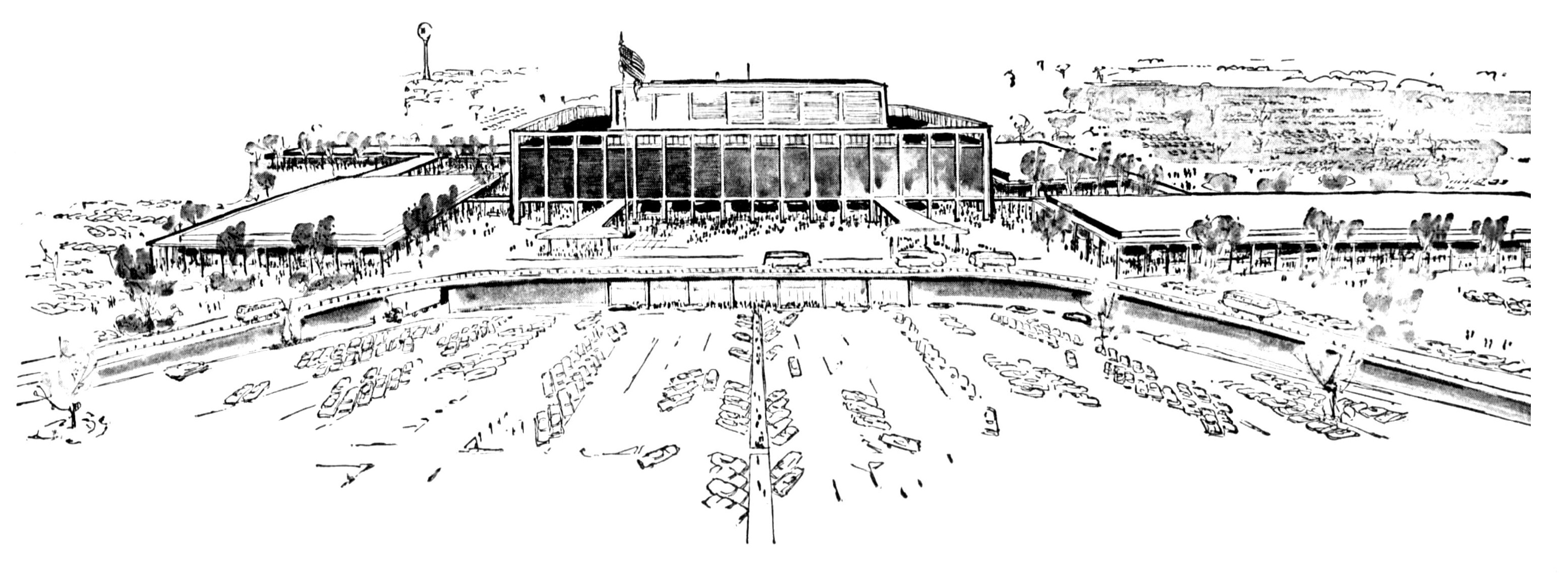

The NORTHLAND J.L. Hudson, with 486,200 square feet, would be the largest branch department store ever built in the United States. The original structure was comprised of 4 levels; Lower (or basement), Middle (or Ground), Upper and Roof. With an addition in 1960, the building's size was increased to 537,000 square feet.

The four directionally-designated malls of the Motor City debuted with Southfield's NORTHLAND CENTER, in 1954. EASTLAND CENTER, in Harper Woods, was completed in 1957. Westland's WESTLAND CENTER was third in line, being dedicated in 1965. SOUTHLAND CENTER, in Taylor, opened in 1970. It would be the fourth -and final- J. L. Hudson shopping mall project.
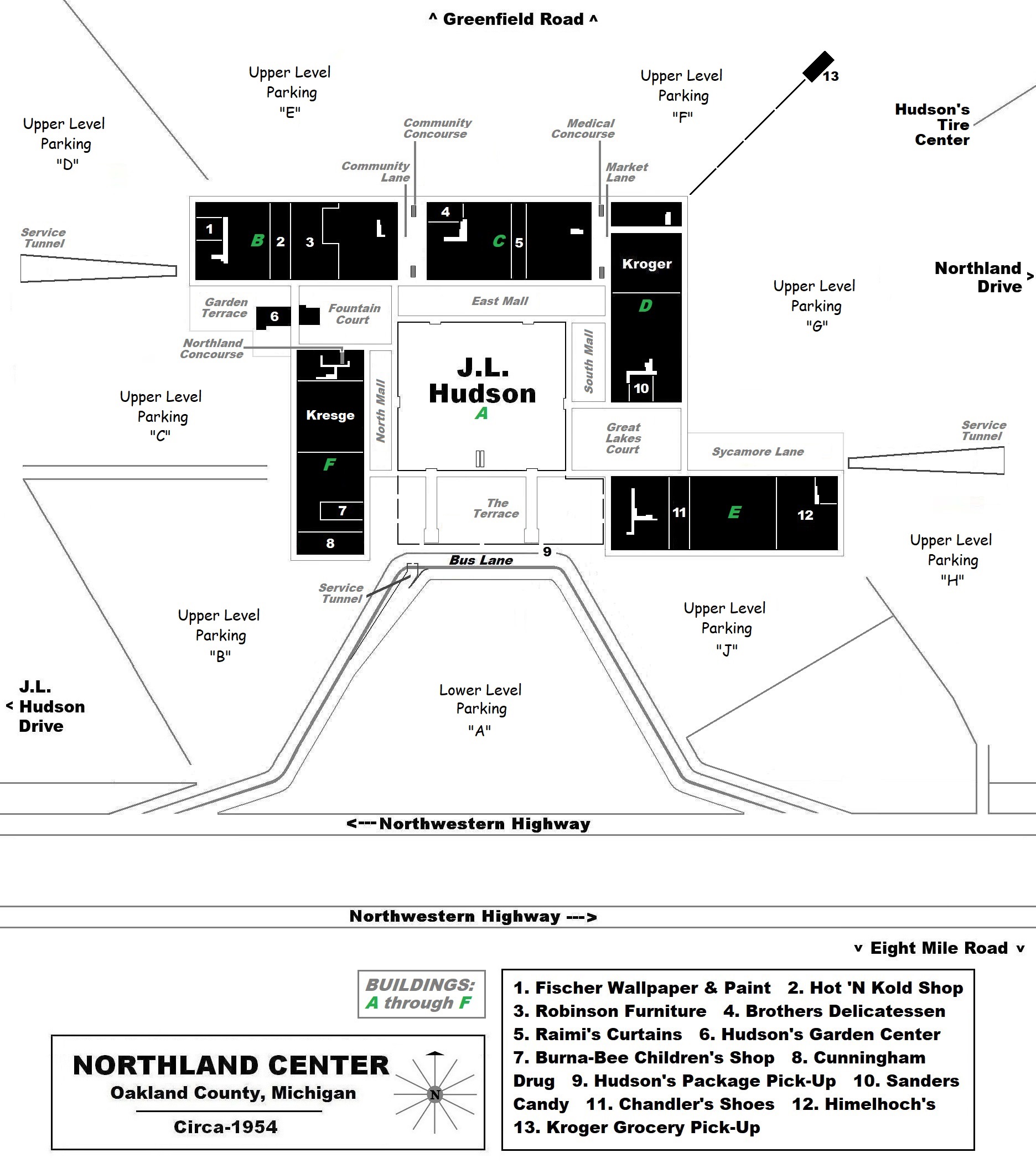
Proclaimed a "shopping paradise," NORTHLAND was America's largest shopping center for its first 2 years in business. The open-air mall encompassed over 1 million leasable square feet and housed an initial sixty-seven stores and services. Its sprawling parking area could accommodate 7,500 autos.
NORTHLAND CENTER TENANTS 1954:
J.L. HUDSON (with The Northland Room restaurant, Piccadilly Circus Cafeteria, Pharmacy, freestanding Garden Center and Tire Center) / S.S. KRESGE 5 & 10 (with luncheonette) / KROGER supermarket / CUNNINGHAM DRUG (with luncheonette) / A.S. Beck Shoes / Albert's ladies' wear / Appearance Shop / Artiste Beauty Salon / Awrey Bakeries / Baker's Shoes / Banner News Agency / Barna-Bee Children's Shop / Better Made Potato Chips / Bloetscher's Meats / Brennan's / Brothers Delicatessen / Center Music Shop / Chandler's Shoes / Community Key Shop / del Gaudio Gifts / Morris Disner & Sons / Dube's Barber Shop / Dunn's Camera & Hobby Center / Elliot Travel Service / Enggass Jewelry Company / Englander Furniture Shops / Fanny Farmer Candies / Father & Son Shoes / Fintex / Fisher Wallpaper & Paint Company / Great Lakes Seafood & Poultry / Nat Green Maternity Modes / Himelhoch's ladies' wear / Hot 'N' Kold Shop electronics & appliances / Household Finance Corporation / Hughes & Hatcher / G.R. Kinney Shoes / Kline's / Thom McAn Shoes / Macauley's / Marianne Shops ladies' wear / Marwil Book Company / Maskell Flowers, Incorporated / Maxwell's Toys & Records / Northland Portait Studio / Palmer's Sandwich Shop / Peter Pan Snack Shop / Phillip's Red Cross Shoes / Queen Cleaners & Dryers / Raimi's Curtains / Robelle Shops / Robinson Furniture / Sallan Jewelers / Sanders Candy / Schiller's Millinery / Stouffer's restaurant (outparcel) / Suzy Hats / The Cotton Shop ladies' wear / The Detroit Bank / The Detroit Free Press / The Detroit News / United Shirt Distributors / US Post Office / Van Horn's men's wear / Wilbur-Rogers / Wright-Kay Jewelers / Zuieback's Suburban ladies' wear
NORTHLAND CENTER TENANTS 1954:
J.L. HUDSON (with The Northland Room restaurant, Piccadilly Circus Cafeteria, Pharmacy, freestanding Garden Center and Tire Center) / S.S. KRESGE 5 & 10 (with luncheonette) / KROGER supermarket / CUNNINGHAM DRUG (with luncheonette) / A.S. Beck Shoes / Albert's ladies' wear / Appearance Shop / Artiste Beauty Salon / Awrey Bakeries / Baker's Shoes / Banner News Agency / Barna-Bee Children's Shop / Better Made Potato Chips / Bloetscher's Meats / Brennan's / Brothers Delicatessen / Center Music Shop / Chandler's Shoes / Community Key Shop / del Gaudio Gifts / Morris Disner & Sons / Dube's Barber Shop / Dunn's Camera & Hobby Center / Elliot Travel Service / Enggass Jewelry Company / Englander Furniture Shops / Fanny Farmer Candies / Father & Son Shoes / Fintex / Fisher Wallpaper & Paint Company / Great Lakes Seafood & Poultry / Nat Green Maternity Modes / Himelhoch's ladies' wear / Hot 'N' Kold Shop electronics & appliances / Household Finance Corporation / Hughes & Hatcher / G.R. Kinney Shoes / Kline's / Thom McAn Shoes / Macauley's / Marianne Shops ladies' wear / Marwil Book Company / Maskell Flowers, Incorporated / Maxwell's Toys & Records / Northland Portait Studio / Palmer's Sandwich Shop / Peter Pan Snack Shop / Phillip's Red Cross Shoes / Queen Cleaners & Dryers / Raimi's Curtains / Robelle Shops / Robinson Furniture / Sallan Jewelers / Sanders Candy / Schiller's Millinery / Stouffer's restaurant (outparcel) / Suzy Hats / The Cotton Shop ladies' wear / The Detroit Bank / The Detroit Free Press / The Detroit News / United Shirt Distributors / US Post Office / Van Horn's men's wear / Wilbur-Rogers / Wright-Kay Jewelers / Zuieback's Suburban ladies' wear

Drawing from the J.L. Hudson Company / Shopping Centers, Incorporated

The main entrance area of the mall consisted of a large open court and city bus stop. A customer pick-up zone for the Hudson's anchor store was on the lower level. The ground level transit terminal above was served by three DSR (Detroit Street Railway) bus routes, one Intertown Suburban Line route and two routes operated by Greyhound.
Photo from http://gruenassociates.com / Gruen Associates
.JPG)
In this snapshot, we see the Hudson's Northland perfume counter.
Photo from http://gruenassociates.com / Gruen Associates
The Hudson's Northland Millinery Department is seen in this vintage image.
Photo from Architectural Digest / June 1954 / Ben Schnall

This full-page ad appeared in the March 25, 1954 editions of a several Wolverine State newspapers. It thanked the local populace for the warm reception given to the newly-opened NORTHLAND shopping center 3 days earlier.
Advert from the J.L. Hudson Company / Shopping Centers, Incorporated

The NORTHLAND CENTER South Mall. The humongous Hudson's Northland anchor store is seen on the right.
Photo from Architectural Digest / June 1954 / Ben Schnall

Here, we see the Fountain Court. Building B and its Hughes & Hatcher apparel store is on the left.
Photo from Architectural Digest / June 1954 / Ben Schnall

Photo from Colourpicture Publishers, Incorporated

Concourses at NORTHLAND CENTER were decorated by several statues. Here we see "Bear & Boy," which was sculpted by Marshall Fredericks.
Photo from Colourpicture Publishers, Incorporated

An 18-acre parcel on the south end of the mall site was developed in the early 1960s. The first Northland Point structure (on the left) was Stouffer's Northland Inn. This 192-room hotel opened in November 1962. Second in line was the Northland Medical Center (lower right). It was dedicated in January 1963. The first building of the Northland Towers (upper center) began leasing office suites in June 1963.
Drawing from the H.L. Vokes Company

Graphic from Suburban Detroit Theaters, Incorporated

The NORTHLAND and EASTLAND centers were enclosed and climate-controlled simultaneously. The 50 million dollar dual renovation of the properties commenced in July 1973. Both mall's emerged fully-enclosed in August 1975.
Graphic from the Dayton Hudson Corporation

A view of the mammoth mall soon after it made the change from outdoor to indoor. A new J.C. Penney may be seen in the lower right. This store, which encompassed 284,000 square feet, was one of the largest in the chain, then based in New York City.
Photo from Malls of America Blogspot


Photo from Library of Congress / Balthazar Korab Studios, Limited


The mall entrance of the aforementioned Target. Encompassing 116,000 square feet, it welcomed first shoppers in March of 1996.
Photo from www.shopatnorthland.com

A snapshot showing Hudson's just before it was refitted with a Marshall Field's nameplate, in August 2001. The store was rebranded as a Macy's in September 2006.
Photo from http://www.history.sandiego.edu

NORTHLAND CENTER turned 60 in March 2014. After all of its years in business, it still held the distinction of largest shopping center in The Wolverine State. The complex covered approximately 1,680,000 leasable square feet and housed 150 store spaces.
Photo from http://www.history.sandiego.edu


When NORTHLAND was enclosed in the 1970s, the "Bear & Boy" statue seen above was moved inside. It was relocated to the Southfield Public Library in May 2016.
Photo from www.shopatnorthland.com

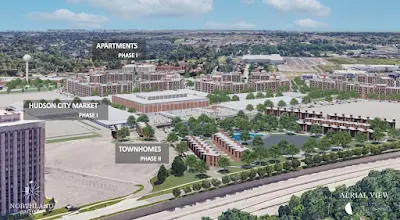
After a failed redevelopment initiative in 2017, the vacant NORTHLAND MALL was sold to Michigan's Contour Companies. They got the proverbial ball rolling and broke ground on the NORTHLAND CITY CENTER project in October 2021. This unique mall repurpose is rebuilding the circa-1954 structures, using their original Mid-Century Modern design aesthetic. Notice the vintage NORTHLAND CENTER signage above.
Drawing from Contour Companies
Drawing from Contour Companies
NORTHLAND CENTER
Northwestern Highway and 8 Mile Road
Oakland County (Southfield), Michigan
Northwestern Highway and 8 Mile Road
Oakland County (Southfield), Michigan
The third mall-type center designed by master architect Victor Gruen was the first that was actually built. NORTHLAND CENTER was situated on a 163-acre tract, located 10 miles northwest of center city Detroit, in an unincorporated section of Oakland County known as Southfield Township. Ground was broken on May 7, 1952.
The complex was a sprawling, 1,040,200 square foot, open-air structure. It encompassed 2 levels. The ground floor was devoted entirely to retail. A basement included lower levels for the larger stores, two subterranean shopping concourses, storage areas, mall offices, a US Post Office, Community Room and truck tunnel network. During the mall's early years, the basement was also maintained as a fallout shelter.
A 4-level (486,200 square foot) J.L. Hudson, the first suburban location in the Detroit-based chain, was situated in the center of the cluster-type mall. This store was surrounded by five retail blocks and seven open court areas. All enclosed structures were air-conditioned and there were twelve escalators. Court areas featured fountains and over 8,000 trees, shrubs and flowering plants. Prerecorded music could be heard over a system of loudspeakers.
Thirteen sculptures had been designed by six artisans. These works included "Water Mobile" and "Fish Group" (by Richard Hall Jennings), "Turtle" (by Arthur Craft),"Baby Elephant" and "Giraffe Family" (by Malcom Moran), "Birds of Flight" (by Gwen Lux) and "Bear & Boy" (by Marshall Fredericks).
The 30 million dollar shopping venue officially opened for business on March 22, 1954, with sixty-seven stores and services. Within months, a total of eighty-one were in operation. At the time of the mall's completion, its 7,500 car parking area was the largest in the world. It was divided into ten lots designated as A through J.
In keeping with the 1950s concept of a regional retail center, the mall was a one-stop shopping destination. In its original configuration, NORTHLAND CENTER included ten dress shops, seven shoe stores, three millinery shops, three jewelry shops, four home furnishing & appliance stores, five men's & boy's shops and four restaurants, as well as a bank, 5 & 10, supermarket, garden supply store, medical clinic, record store, drug store, beauty parlor, lost children office and 300-seat Community Room. The mall even had its own fire department.
Charter tenants included Hughes & Hatcher men's wear, Winkelman's and Himelhoch's ladies' wear, Barna-bee Children's Shops, Robinson Furniture, Baker's Shoes, Chandler's Shoes, Sanders Candy, the Hot 'N' Kold Shop (home appliances & electronics), a Kroger supermarket and S.S. Kresge 5 & 10.
The area surrounding -and including- the shopping center was incorporated, as the City of Southfield, in April 1958. Vehicular access was improved in 1962, when the James Couzens (later John C. Lodge) Expressway was extended from Detroit's Wyoming Avenue to 8 Mile Road.
By this time, other shopping malls were being developed in the NORTHLAND trade area. These included LIVONIA MALL (1964-2009) {6.8 miles southwest, in Livonia}), WESTLAND CENTER (1965) {11.9 miles southwest, in Westland}and TEL-TWELVE MALL (1968-2001) {4.7 miles northwest, also in Southfield}.
As a result, NORTHLAND CENTER had been expanded. Hudson's added a 5th floor in 1960, with the store enlarged to 537,000 square feet. The Building G and Building H blocks, on the south end of the complex, were completed in the early '60s, adding stores such as Tall Eez Shoes and Best & Company. Stores in Building I, on the mall's north end, began opening in the fall of 1969. These included G.Q. Modern Shoppe, Barclay Gallery Limited and B. Dalton Bookseller.
The first -and only- motion picture venue to operate at the mall was built adjacent to its north parking area. The Suburban Detroit Theaters, Incorporated Northland Theatre debuted on November 17, 1966. The cinema was twinned in November 1976 and came under the American Multi-Cinema brand in June 1986. It was shuttered in January 1990 and re-opened as Millenium Center -a Bollywood and live-performance venue- in April 2000.
Meanwhile, a mall-wide NORTHLAND renovation was done between July 1973 and August 1975. A 2-level (284,000 square foot) J.C. Penney was built on the northeast corner. The store opened its doors, in unison with a brand new EASTLAND location, on May 21, 1975. The second phase of the 25 million dollar remodeling enclosed the mall. NORTHLAND CENTER re-opened, as a fully-enclosed shopping facility, on August 3, 1975. With its twenty-one store expansion, it now encompassed approximately 1.5 million leasable square feet and featured 102 stores and services.
A bus stop area at the front of the shopping hub was filled with a new block of inline stores in 1980-1981. By the mid-1980s, several major tenants had vacated, including S.S. Kresge, Jo-Ann Fabrics and The Limited. Illinois-based MainStreet joined the tenant list on March 12, 1988. This 1-level (61,000 square foot) store would be rebranded by Wisconsin-based Kohl's on March 19, 1989.
A new decade brought a 7 million dollar indoor-outdoor face lift. New lighting, ceilings, flooring and skylights were installed. An 8-bay Food Court was created in existing mall space. The culinary complex opened in November 1991.
Montgomery Ward gutted store space in two northwest blocks, creating a 2-level (118,400 square foot) store. This opened for business on November 19, 1994. A (40,300 square foot) T.J. Maxx had welcomed its first customers on November 10th. The next expansion extended NORTHLAND CENTER southeast. A 1-level (116,000 square foot) Target made its debut on March 10, 1996.
Montgomery Ward closed its "underperforming" store in early 1998. J.C. Penney was shuttered in June of the year 2000. Kohl's pulled out of the mall in 2004. The old Montgomery Ward was leased to National Wholesale Liquidators, who opened in October 2004 but closed in November 2008. Hudson's was rebranded as Marshall Field's in August 2001 and morphed into a Macy's in September 2006.
The shuttering of the NORTHLAND CENTER Target, on February 1, 2015, left the massive mall with just one anchor to sustain it. Cincinnati's Macy's Inc. announced that the mall's primary anchor would also be closing. This transpired on March 23, 2015, leaving the historic shopping hub anchor-less.
By this time, the owners of NORTHLAND CENTER had defaulted on a 31 million dollar loan, sending the property into receivership. 3 million dollars were also owed in back taxes and utility bills. An estimated 6 million dollars were needed to complete various repairs to the 1,680,000 square foot structure. In February 2015, an Oakland County judge approved plans to vacate and shutter the historic shopping hub. It closed on April 10, 2015.
Between the mid-1990s and early 21st century, ownership of NORTHLAND CENTER had changed four times. The fourth transaction, which closed in October 2015, transferred the deed of the shuttered shopping center to the City of Southfield. Demolition of the Target and Firestone buildings commenced in October 2017. IMAGINE NORTHLAND, a redevelopment plan for the remainder of the mall, was drawn up but eventually abandoned.
In July 2021, Contour Companies, of Bloomfield Hills, Michigan, acquired the mall. Bruce Kopytek, Chief Architect, would oversee its redevelopment as NORTHLAND CITY CENTER. Under this plan, the original anchor store would be restored and reconfigured as the Hudson City Market.
This facility would include a food hall, entertainment venues, home furnishings mart and leased office spaces. The inline store sections of the original mall would be repurposed as 254 loft apartments. The J.C. Penney and Main Street-Kohl's structures, added to NORTHLAND CENTER in the 1970s and '80s, would be demolished.
Multi-story buildings, containing apartments, town homes and street-level retail, would be built, with patches of greenspace and parking facilities also created. Old and new structures would incorporate the Mid-Century Modern architecture used for the original 1954 mall. Ground was broken for Phase One on October 7, 2021. It is projected that Phases One and Two will be complete by 2027.
Sources:
The Detroit Free Press
The Milwaukee Journal
The Record-Eagle (Traverse City, Michigan)
The Ottawa Citizen (Ottawa, Ontario)
The Birmingham Eccentric (Birmingham, Michigan)
"Shopping Centers: Locating Controlled Regional Centers" Eugene J. Kelley -1956
preservenet.cornell.edu/publications/Longstreth Branch Store.doc
http://www.michiganhighways.org
http://cinematreasures.org
Northland Center Leasing Plan / GP Northland Center, LLC
"Images of Modern America - Northland Mall" / Gerald E. Naftaly
http://www.shopatnorthland.com
http://www.aacrealty.com / Ashkenazy Acquisition Corporation
http://www.crainsdetroit.com
http://www.imaginenorthland.com
www.michigansthumb.com
https://www.contourcompanies.com
https://apnews.com
https://www.cnu.org
FAIR USE OF NORTHLAND CENTER IMAGES:
The images from Architectural Digest / June 1954 illustrate a key moment in the mall's history that is described in the article. The images are not replaceable with free-use or public-domain images. The use of the images does not limit the copyright owners' rights to distribute the images in any way. The images are being used for non-profit, informational purposes only and their use is not believed to detract from the original images in any way.


A mid-'60s VALLEY FAIR view, with the adjacent STEVENS CREEK PLAZA in the upper left corner. The California Route 17 expressway runs along the bottom of the photo (or the east side of VALLEY FAIR CENTER). The highway was opened to traffic in the late 1950s.
Photo from Malls of America Blogspot

A stunning nighttime shot of the VALLEY FAIR CENTER Macy's, showing its high-end, Mid-Mod design.
Photo from http://www.flickr.com / "HmDavid"

A shopping concourse in the original VALLEY FAIR CENTER.
Photo from http://www.flickr.com / "HmDavid"

In the mid-1980s, the bulk of VALLEY FAIR CENTER was demolished. Its Macy's was incorporated into a newly-built, connecting corridor mall (shown in light gray). It linked the store with structures originally part of STEVENS CREEK PLAZA (indicated in black). The amalgamated shopping hub was called simply VALLEY FAIR. Over on the east side, the route of California 17 had been redesignated as Interstate 880.

WESTFIELD SHOPPINGTOWN VALLEY FAIR TENANTS 2002:
MACY'S WOMEN'S (with Styling Salon and Boudin Sourdough Bakery) / MACY'S MEN'S / NORDSTROM (With Nordstrom Cafe) / SAFEWAY supermarket (ouptrarcel) / 800 Pillows.com / Abe / abercrombie children's wear / Abercrombie & Fitch apparel / Aeropostale apparel / Aerosoles shoes / Aldo shoes / American Eagle Outfitters / Anchor Blue apparel / Ancient Creations jewelry / Ann Taylor ladies' wear / April Cornell ladies' wear / Apple Store / A|X Armani Exchange apparel / Arden B. ladies' wear/ Aveda cosmetics / Bailey, Banks & Biddle Jewelers / Bakers shoes / Barcelinoa / Bare Escentuals / Banana Republic Flagship apparel / Bang & Olufsen home electronics / Bank of America (outparcel) / Bath & Body Works cosmetics / Bebe ladies' wear / Ben Bridge Jeweler / Benetton / Body Options / Bose home electronics / Boss Hugo Boss apparel / Brentanos Books / Brighton Collectibles / Brookstone electronics / Build-A-Bear Workshop / Cache ladies' wear / California Cafe / California Pizza Kitchen / Canyon Beachwear / Casa de Fruta / Cathy Jean shoes / Charles David shoes / Charlotte's Room / Claire's accessories / Clarks shoes / Clinique (kiosk) / Club Monaco ladies' wear / Coldwater Creek ladies' wear / Coach accessories / Copeland's Sports / Crabtree & Evelyn cosmetics / Creative Jewelers / Creative Jewelry / Crescent Jewelers/ Crocodile Cafe / Davante / Davidson & Licht Jewelers / Discovery Channel Store / Doctor Holbert, Optometrist / Easy Spirit shoes / EBX / Eddie Bauer apparel / Electronics Boutique / Enzo Angiolini shoes / Express ladies' wear / Fantasy Beauty Spa / Fashionize / Florsheim Shoes / Foot Locker / Forever 21 young ladies' wear / Franklin Covey-Quest / Fred Meyer Jewelers / Gap Kids children's wear / Gary's Tux Shop / Godiva Chocolatier / Goodyear Tire & Auto (outparcel) / Grain D'Or Restaurant / Great Earth Vitamins / Guess? apparel / Gymboree children's wear / Hat World / Helzberg Diamonds / Hot Topic apparel / Icing by Claire's / Illuminations / Impostors / J. Crew apparel / Jayne's Hallmark / J. Jill ladies' wear / Jessica McClintock ladies' wear / Johnston & Murphy shoes / Journeys Kidz / Journeys shoes / Jurlique the Spa Store/ Kay-Bee Toys / Kenneth Cole men's wear / Kids Footlocker / King of Knives / L'Uomo men's wear / Lady Foot Locker / Lane Bryant ladies' wear / Le Parfum / Leonidas Chocolates / Lens Crafters 2000 / Lens Crafters Optique / Limited Too ladies wear / Liz Claiborne Petites / Longs Drugs (outparcel) / Louis Vuitton / Lucky Brand Dungarees / Lucy ladies' wear / LuNa Hoku jewelry / Lundstrom Jewelers / Malm Luggage / Martin Lawrence Galleries / M.A.C. cosmetics / MasterCuts / Max Mara ladies' wear / Max Studio / Mimi Maternite / Mishmash / Mr. Rags men's wear / Mont Blanc / Morgan of Paris / Naartjie / Nextel Cellular Origins / Nine West shoes / Organized Living / Pacific Sunwear / Papyrus stationers / Petite Sophisticate ladies wear / Pottery Barn housewares / Pottery Barn Kids children's wear / Prints Plus / Rampage ladies' wear / Regis Hairstylists / Ritz Camera One Hour Photo /Restoration Hardware / Rockport shoes / St. Croix Shop men's wear / Stride Rite shoes / Structure / Sam Goody Music / Samuel's Jewelers / Sanrio / See's Candies / Sharper Image / Silver & Gold Connection / Sephora cosmetics / Solstice / Speedo / Spencer Gifts / Starbucks Coffee / Stern's Luggage / Steve Madden shoes / Structure / Suncoast Motion Picture Company / Sunglass Hut / Sunglass Hut Sport / Sun Shade Optique I / Sun Shade Optique 2 / Sushi Boat / Swarovski / Swatch / Sweet Factory / Talbots / The Body Shop cosmetics / The Bombay Company home furnishings / The Children's Place children's wear / The Disney Store / The Gap apparel / The Jewelry Box / The Museum Company / The Picture People portait studio / The Right Start / The Sak / The Sleep Number Store by Select Comfort / The Walking Company shoes / Tie Rack / Things Remembered / Thomas Kinkade Gallery / Tie Rack / Tiffany & Company / Timberland / Tommy Hilfiger men's wear / Trade Secret / Trend By L' Uomo men's wear / Victoria's Secret cosmetics / Yankee Candle Company / Washington Mutual Bank (outparcel) / Watch Station / Watch World International / Wells- Fargo Bank (outparcel) / Wet Seal ladies' wear / Wetzel's Pretzels / Whitehall Company Jewellers / Wig 'N Out / Williams-Sonoma housewares / Wilson's The Leather Experts / Winners / Zales Jewelers / Zumiez apparel / Zutopia apparel
FOOD COURT:
Auntie Anne's Pretzels / Boudin Sourdough Bakery / California Crisp / Cinnabon / Great Khan's Mongolian Festival / Ivar's Seafood Bar / Jamba Juice / McDonald's hamburgers / Mrs Fields Cookies / Muscle Beach Lemonade / Panda Express / Rubio's Baja Grill / Sarku Japan / Sbarro the Italian Eatery / Steak Escape

WESTFIELD VALLEY FAIR in 2014. The mall has just emerged from a minor redo, where two sections were remodeled. Near Nordstrom, a "Luxury Collection" was created. On Level 2, the existing Food Court was refashioned into a "Dining Terrace".

The uber upscale Luxury Collection wing features names such as Cartier, TAG Heuer and Wolford. Stores heralded as "fashion forward" and "first-to-market" translate to very expensive.
Drawing from www.westfield.com / The Westfield Corporation

The new Dining Terrace features Pizza Vino Bar, Super Duper, Chicken Wow, Old Port Lobster and Panda Express...to name a few.
Drawing from www.westfield.com / The Westfield Corporation

If the mall wasn't already big enough, it certainly was when a 1.1 billion dollar expansion was completed. A long-delayed remodeling got underway in 2016. By 2020, a 2,200,000 square foot buying behemoth featured a fourth anchor (Bloomingdale's). There were also a third major shopping concourse, two high-tech "digital garages" and a movie theater (the first in the mall's 60-year history).

The new VALLEY FAIR Bloomingdale's was dedicated, along with the mall expansion, in March 2020.
Photo from https://westfieldus.app.box.com / Christina Mendez
VALLEY FAIR CENTER
Stevens Creek Boulevard and California Route 17 (Interstate 880)
San Jose, California
In December 1965, Macy's California established full ownership of the shopping center. A 78,600 square foot fourth level had been added to the Macy's, taking space previously used for the "rooftop fair." The store now encompassed 235,900 square feet. By 1970, the shopping hub was officially promoted as VALLEY FAIR MALL.
Stevens Creek Boulevard and California Route 17 (Interstate 880)
San Jose, California
One of the early shopping mall projects of Austrian architect Victor Gruen, VALLEY FAIR CENTER was built on a 41-acre tract, located 5.5 miles southwest of San Jose's Central Business District. Ground was broken for the first mall phase on July 20, 1955. The open-air complex was developed by a joint venture of Macy's California and San Francisco's Capital Company. While the inline store section was designed by Victor Gruen, its anchor department store was designed by San Francisco's John Savage Bolles.
A 3-level (157,300 square foot) Macy's became the first operational VALLEY FAIR store on August 10, 1956. The grand opening was attended by Ernest L. Malloy (Macy's California president) and Harry McClelland (Capitol Company president). A ceremonial ribbon was cut by Joseph C. Kresse (Macy's Valley Fair manager) and Joan Beckett, "Miss California 1956."
Sommer & Kaufmann Shoes opened on March 22, 1957. Eight inline stores began business on April 5th; C.H. Baker Shoes, Leeds Qualicraft Shoes, Thom McAn Shoes, Webster's Shoes, Grodins, See's Candies, Kathy Don children's wear and 2-level F.W. Woolworth 5 & 10. Joseph Magnin welcomed first shoppers on August 8th. When fully-realized, the 488,000 square foot shopping hub featured fifty-five stores and services.
VALLEY FAIR CENTER was known for the carnival rides that had been installed on the roof of Macy's. Included were a 40-foot ferris wheel, merry-go-round and mini-train. These attractions were removed in late 1957. The mall was adjacent to an 8.8 mile stretch of the California Route 17 / San Jose-Los Gatos Freeway. This thoroughfare opened to traffic on May 1, 1959.
Competing shopping centers were springing up in -and around- San Jose. These included EASTRIDGE MALL (1971) {6.9 miles east, in southeast San Jose}, OAKRIDGE MALL (1973) {6.4 miles southeast, in San Jose}, VALLCO FASHION PARK (1976) {3.3 miles west, in Cupertino} and SUNNYVALE TOWN CENTER (1979-2007) {5.5 miles northwest, in Sunnyvale}.
VALLEY FAIR MALL was sold to El Segundo, California-based Ernest W. Hahn, Incorporated. In November 1980, the company's assets were acquired by Calgary's Trizec Corporation, Limited. In the fall of 1996, a new entity, known as Trizec-Hahn, was created.
Meanwhile, in 1985, Trizec had acquired STEVENS CREEK PLAZA. They started a large-scale renovation of the PLAZA and the adjacent VALLEY FAIR MALL. The bulk of VALLEY FAIR was razed, leaving only Macy's and its parking garage standing. The department store, expanded by 160,000 square feet, would now comprise 396,000 square feet.
A 100 million dollar, 2-level mall concourse was built. This linked Macy's with the Emporium and I. Magnin at the old STEVENS CREEK PLAZA. At the center of the center was a 2-level (168,000 square foot) Nordstrom. Renamed simply VALLEY FAIR, the amalgamated mall encompassed 1.2 million leasable square feet. 112 stores -out of an eventual 175- were dedicated on October 15, 1986.
Major retail complexes in the VALLEY FAIR trade area now included WESTGATE MALL (1960) {2.9 miles southwest, in Campbell} and GREAT MALL OF THE BAY AREA (1994) {6.4 miles northeast, Milpitas}.
Anchor stores at VALLEY FAIR changed nameplates during the 1990s. I. Magnin closed in May 1992. Its building was leased as Copeland Sports, which eventually morphed into Sports Authority. The Emporium was expanded with an additional (85,000 square foot) third level, for a grand total of 316,000 square feet. This store was rebranded as a Macy's Men's & Home Store in 1996.
In 1998, TrizecHahn sold VALLEY FAIR to a joint venture of Australia-based Westfield Holdings (now Westfield, Incorporated) and the Maryland-based Rouse Company. Westfield soon established full ownership of the venue and renamed it WESTFIELD SHOPPINGTOWN VALLEY FAIR. This was truncated to WESTFIELD VALLEY FAIR in June 2005.
Meanwhile, a major expansion had begun in late 1998. The project, encompassing three phases of construction, included two parking garages and a new 3-level (225,000 square foot) Nordstrom. A fifty-store, wrap-around concourse (built north of the existing mall and connecting the original Macy's and second Nordstrom) was dedicated in 2001. The circa-1986 Nordstrom was then sectioned into thirty store spaces. The renovated retail hub was re-dedicated on May 22, 2002.
2006 brought news of a third major expansion of the 1,475,600 square foot, 262-store, WESTFIELD VALLEY FAIR. The project was to add 650,000 leasable square feet in a second wrap-around concourse of seventy-two stores. This would be built on the south side of the existing mall, replace a parking garage, and connect the two Macy's stores.
Two new anchors, a 2-level (120,000 square foot) Neiman Marcus and 3-level (150,000 square foot) Bloomingdale's, would be included in the new concourse. Moreover, the existing Safeway supermarket and CVS Drug, outparcels of the circa-1964 STEVENS CREEK PLAZA, would be relocated to new structures and a parking garage would be built to replace the parking structure being demolished.
The project was approved by the local government in November 2007. However, The Great Recession derailed the prospective renovation. It was put on indefinite hold in May 2009. In the meantime, a refurbishment of two sections of the existing mall was carried out. Work started in September 2012. The Food Court on Level 2 was gutted and rebuilt as a more upscale "Dining Terrace." It encompassed 23,000 square feet and eighteen eateries.
On Level 2 of the mall, just east of Nordstrom, tenants were relocated to other spaces in the mall. The concourse became a "Luxury Collection" of high-end retailers, with names such as Cartier, Burberry, TAG Heuer, Wolford, Prada and Zara. These new sections of WESTFIELD VALLEY FAIR were officially dedicated November 1, 2013.
Sources:
The Peninsula Times-Tribune (Palo Alto, California)
A 100 million dollar, 2-level mall concourse was built. This linked Macy's with the Emporium and I. Magnin at the old STEVENS CREEK PLAZA. At the center of the center was a 2-level (168,000 square foot) Nordstrom. Renamed simply VALLEY FAIR, the amalgamated mall encompassed 1.2 million leasable square feet. 112 stores -out of an eventual 175- were dedicated on October 15, 1986.
Major retail complexes in the VALLEY FAIR trade area now included WESTGATE MALL (1960) {2.9 miles southwest, in Campbell} and GREAT MALL OF THE BAY AREA (1994) {6.4 miles northeast, Milpitas}.
Anchor stores at VALLEY FAIR changed nameplates during the 1990s. I. Magnin closed in May 1992. Its building was leased as Copeland Sports, which eventually morphed into Sports Authority. The Emporium was expanded with an additional (85,000 square foot) third level, for a grand total of 316,000 square feet. This store was rebranded as a Macy's Men's & Home Store in 1996.
In 1998, TrizecHahn sold VALLEY FAIR to a joint venture of Australia-based Westfield Holdings (now Westfield, Incorporated) and the Maryland-based Rouse Company. Westfield soon established full ownership of the venue and renamed it WESTFIELD SHOPPINGTOWN VALLEY FAIR. This was truncated to WESTFIELD VALLEY FAIR in June 2005.
Meanwhile, a major expansion had begun in late 1998. The project, encompassing three phases of construction, included two parking garages and a new 3-level (225,000 square foot) Nordstrom. A fifty-store, wrap-around concourse (built north of the existing mall and connecting the original Macy's and second Nordstrom) was dedicated in 2001. The circa-1986 Nordstrom was then sectioned into thirty store spaces. The renovated retail hub was re-dedicated on May 22, 2002.
2006 brought news of a third major expansion of the 1,475,600 square foot, 262-store, WESTFIELD VALLEY FAIR. The project was to add 650,000 leasable square feet in a second wrap-around concourse of seventy-two stores. This would be built on the south side of the existing mall, replace a parking garage, and connect the two Macy's stores.
Two new anchors, a 2-level (120,000 square foot) Neiman Marcus and 3-level (150,000 square foot) Bloomingdale's, would be included in the new concourse. Moreover, the existing Safeway supermarket and CVS Drug, outparcels of the circa-1964 STEVENS CREEK PLAZA, would be relocated to new structures and a parking garage would be built to replace the parking structure being demolished.
The project was approved by the local government in November 2007. However, The Great Recession derailed the prospective renovation. It was put on indefinite hold in May 2009. In the meantime, a refurbishment of two sections of the existing mall was carried out. Work started in September 2012. The Food Court on Level 2 was gutted and rebuilt as a more upscale "Dining Terrace." It encompassed 23,000 square feet and eighteen eateries.
On Level 2 of the mall, just east of Nordstrom, tenants were relocated to other spaces in the mall. The concourse became a "Luxury Collection" of high-end retailers, with names such as Cartier, Burberry, TAG Heuer, Wolford, Prada and Zara. These new sections of WESTFIELD VALLEY FAIR were officially dedicated November 1, 2013.
In 2015, the long-awaited expansion of the mega mall was revived. The original plan for two new anchor stores was amended to include only a 3-level (150,000 square foot) Bloomingdale's. Construction commenced in early 2015 on a high-tech "digital garage," which was replacing an existing structure at the northeast corner of the mall site.
The new garage was dedicated in late 2015. Following this, an existing parking structure at the front of the shopping hub (running along Stevens Creek Boulevard) was demolished; this to provide room for the new Bloomingdale's, Outdoor Dining Terrace and second "digital garage." A state-of-the-art cinema would also to be installed in another area of the mall.
On January 19, 2019, the Kerasotes San Jose Showplace ICON cinema opened for business. The mall addition and new Bloomingdales were officially dedicated on March 5, 2020. WESTFIELD VALLEY FAIR now spanned around 2,200,000 leasable square feet and housed 272 stores, restaurants and entertainment venues.
Westfield's American and European property portfolio had been merged into the holdings of Paris-based Unibail-Rodamco in June 2018. A new company, known as Unibail-Rodamco-Westfield, was created. Unibail-Rodamco-Westfield began selling its American mall properties off in 2022.
The Peninsula Times-Tribune (Palo Alto, California)
The San Francisco Business Chronicle / Renee Frojo
The San Bernardino County Sun
The Santa Maria Times (Santa Maria, California)
www.renewvalleyfair.com
www.cestcop.com / Mike Carrol Productions
http://www.bigmallrat.com
www.renewvalleyfair.com
www.cestcop.com / Mike Carrol Productions
http://www.bigmallrat.com
http://www.westfield.com (website on Internet Archive Wayback Machine)
Santa Clara County tax assessor website
www.cahighways.org
Santa Clara County tax assessor website
www.cahighways.org
www.reuters.com
https://www.mercurynews.com
"Westfield Valley Fair" article on Wikipedia


Autumn 1954 and America's first regional-class, fully-enclosed shopping mall is in the early stages of construction.
Photo from http://www.mnhs.org / Minnesota Historical Society / Southdale Mall

By the autumn of 1956, finishing touches are being added to the indoor Garden Court.
Photo from http://www.mnhs.org / Minnesota Historical Society / Southdale Mall

Click on the arrow to watch a short film about Greater Minneapolis' revolutionary SOUTHDALE CENTER.

By the autumn of 1956, finishing touches are being added to the indoor Garden Court.
Photo from http://www.mnhs.org / Minnesota Historical Society / Southdale Mall

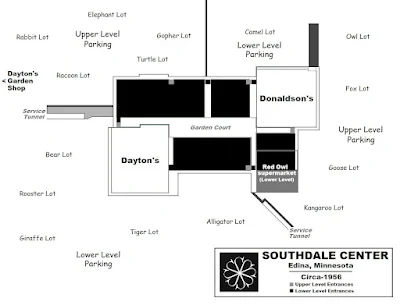
October 8, 1956. SOUTHDALE CENTER opens for business. The complex encompasses over 800,000 leasable square feet and will eventually house seventy-five stores and services.
Photo from http://www.mnhs.org / Minnesota Historical Society / Southdale MallClick on the arrow to watch a short film about Greater Minneapolis' revolutionary SOUTHDALE CENTER.
Video from University of Wyoming American Heritage Center / Victor Gruen Papers
SOUTHDALE CENTER TENANTS 1956:
DAYTON COMPANY (with Valley View Room restaurant and public auditorium) / L.S. DONALDSON (with Minnesota Room restaurant and public auditorium) / RED OWL supermarket / F.W. WOOLWORTH (with luncheonette) / Anderson Shop China & Glassware / The Cotton Shop / Bachman's Florist / Roy H. Bjorkam, Inc. ladies' wear / Boutell's Furniture / Bringold Meats / Suzy Hats / Brown Photo / Buttrey Stores, Incorporated ladies' wear / Chandler's Shoes / Baker's Shoes / DeLaria Delicatessen / Edina Liquor Store / Egekvist Bakery / Fanny Farmer Candies / Farm & Orchard Fruits & Vegetables / Farnham Stationers & School Supplies / First Southdale National Bank / Gager's Handicraft / Flagg Brothers Shoes / John W. Heller ladies' wear / Household Finance Corporation / Jack & Jill Children's Shop / J.B. Hudson Jewelers / Jackson-Graves ladies' wear / Juster Brothers men's wear / Juvenile Shoes / Kelco Storeware / G.R. Kinney Shoes / Kiddie Koral children's amusement area (with zoo) / Fashion Beauty Salon / Marshall Wells Hardware / Minneapolis Gas Company / Mode O'Day Frock Shop / Marvin Orek & Associates ladies' wear / Peck & Peck / The Purple Door Greeting Cards / Pets Unlimited / Peter Pan Restaurant / The Record Shop / Richman Brothers men's wear / P. Schlampp & Sons Furiers / Shirley's Maternity Fashions / Sidewalk Cafe / Slenderella Figure Salon / Southdale Men's Store / Southdale Appliance Repair Center / The Toy Fair / Thorpe Brothers Real Estate / United States Post Office / Walgreen Drug (with luncheonette) / Walter's, Incorporated ladies' wear / White Way Cleaners / Wirt Wilson & Company
OUTPARCELS:
Southdale Garden Center / Pure Oil service station / Western Oil & Fuel Company
Subscribe to:
Posts (Atom)